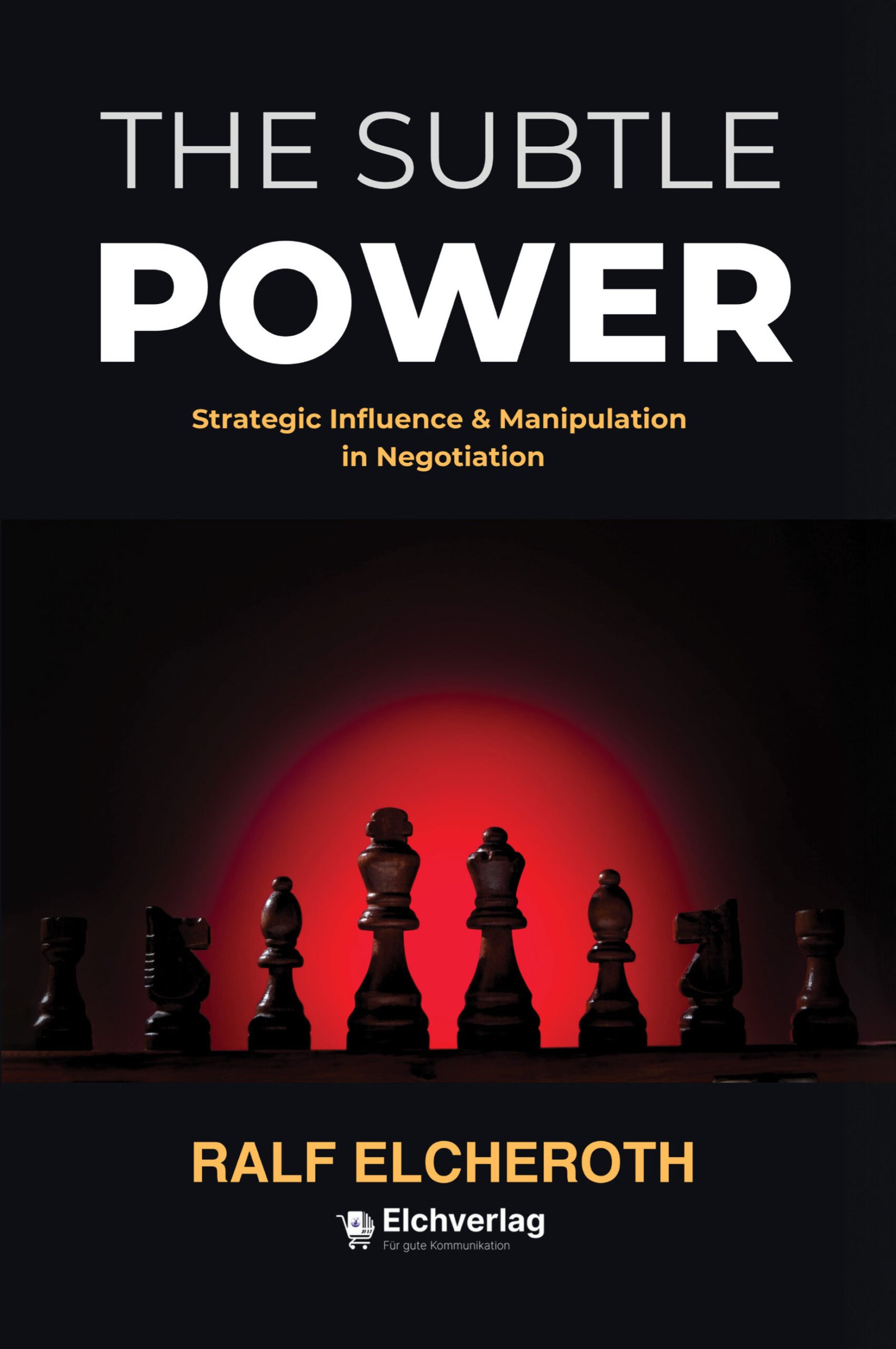
„The most dangerous opponent is not the one across the table. It is the one who knows the game you don’t realize you’re playing.“
A Map and a Toolkit — for Both Sides of the Table
Most negotiation books teach you to close deals. The Subtle Power teaches you to see the board. It covers the full spectrum — from subtle persuasion through language to overt psychological pressure — and gives you both the offensive and defensive playbook.
The core organizing principle is the Fair/Unfair Criteria Matrix: every tactic is evaluated for effectiveness and fairness, so you understand not just what works, but what costs you trust. That’s the distinction that makes this book different from standard sales or procurement training.
30+ Techniques Across Three Arcs
Subtle Persuasion
Anchoring, framing, active listening as information extraction, yes-path sequences, foot-in-the-door escalation — the invisible levers of language.
Verbal Pressure
Authority projection, bluffing, killer phrases, moral blackmail, the perfection trap, cognitive overload — and how to recognize them in real time.
Emotional & Silent Signals
Scarcity tactics, loss aversion exploits, body language, micro-expressions, proxemics, tone — the non-verbal dimension most negotiators ignore.
Deep Manipulation
The virus technique, repetition as illusion of truth, the salami method, black-and-white framing, doom-saying — covert tactics that work below awareness.
Cognitive Bias Exploitation
Priming, anchoring bias, the decoy effect, endowment effect, reciprocity traps, sunk-cost loyalty — why even experts get played.
Defensive Playbook
Countermeasures, reflection questions, and ready-made language to hold your position without destroying the relationship.
The Fair / Unfair Criteria Matrix
A central tool in the book. Every tactic is rated on two axes — how well it works, and what it costs you in trust. This isn’t about moralizing; it’s about knowing your trade-offs.
| Tactic | Effectiveness | Fairness | Verdict |
|---|---|---|---|
| Active listening & strategic silence | High | High | Use freely |
| Anchoring with a strong opening offer | High | Neutral | Standard practice |
| Artificial scarcity („Sign today or lose it“) | Moderate | Low | Erodes trust |
| Cognitive overload (200-page data dump) | High short-term | Very low | Burns the relationship |
| Framing (loss vs. gain) | High | Context-dependent | Use with awareness |
| Moral blackmail | Moderate | Very low | Avoid |
What You Will Be Able to Do
How This Book Differs from Other Negotiation Titles in the Elchverlag Portfolio
The Subtle Power
- Written in English — for international B2B readers
- Focus: recognizing and countering manipulation
- Includes a full defensive playbook
- Introduces the Fair/Unfair Matrix as an ethical compass
- Covers non-verbal and silent manipulation signals
- Based on Cialdini, Kahneman/Tversky, and Ariely
Other Elchverlag Negotiation Titles
- German language audience
- Focus: applying pressure or holding your ground tactically
- Procurement-specific scenarios (single-source, price increases)
- Principle-based frameworks (non-violent, polite-but-firm)
- Primarily verbal and strategic
How to Recognize When You Are Being Manipulated in a Negotiation
You did your homework. You knew the market rates, you had your BATNA, and you walked in prepared. But somewhere during the meeting, the conversation shifted — and you ended up agreeing to terms you had no intention of accepting. Sound familiar? You are not alone, and you were probably not outlogicked. You were outplayed psychologically.
This is not about being naive or inexperienced. Research by Kahneman and Tversky shows that even expert negotiators — procurement managers, M&A lawyers, experienced sales directors — are reliably vulnerable to specific psychological techniques. The reason: these tactics exploit cognitive shortcuts your brain uses under pressure. They are invisible precisely because they feel like normal conversation.
The Five Most Common Signs You Are Being Manipulated
1. You feel sudden urgency you cannot explain. The deal was fine yesterday. Now there is a deadline, a competing offer, or a „limited slot.“ Artificial scarcity is one of the most widely used tactics in B2B negotiations — it exploits loss aversion, the documented tendency to fear losing an option more than we value gaining an equivalent one. Ask yourself: is this scarcity verifiable? If not, name it calmly: „Can you confirm that timeline in writing?“
2. You are drowning in information. A 200-page compliance document lands two days before signing. A presentation full of technical data that only tangentially addresses your questions. This is cognitive overload — a deliberate tactic designed to exhaust your decision-making capacity and create „panic compliance.“ Real-world M&A cases document how sellers have signed liability clauses worth millions simply because their team was too overwhelmed to read properly.
3. The first number on the table feels like the baseline. It is not. Anchoring — the tendency of the first figure mentioned to disproportionately shape all subsequent discussion — is one of the most robust findings in negotiation psychology. If you catch yourself thinking „well, they opened at X, so Y is a reasonable compromise,“ you have already been anchored. The counter-move: reject the anchor explicitly. „That figure is not in our range. Let’s start from market data.“
4. You said yes to a series of small, reasonable-sounding questions. „Would you agree that reliability matters? That penalties for delay are fair? That a long-term partnership creates more value?“ Each yes seemed obvious. But you have just walked the yes-path — a deliberate sequence designed to build psychological momentum toward a larger commitment you would have resisted if asked directly. The moment you notice a pattern of easy agreements, pause before the next one.
5. An authority figure entered the room without contributing anything substantive. A Chief Risk Officer who observes but says little. A senior executive who „stops by.“ A presentation opening with a World Economic Forum reference. Authority signals are deployed to trigger deference — to shift your brain into System 1 mode, where you accept claims without scrutiny. The defense: separate status from substance. Ask the same hard questions regardless of who is in the room.
The Defense Is Awareness — and Prepared Language
The single most effective counter to manipulation is real-time recognition. Once you can name the tactic, its power drops significantly. „I notice we have a sudden deadline that wasn’t there last week“ — said calmly, not accusatorially — reframes the dynamic immediately. Prepared language matters: having a set of neutral, firm responses ready before you walk into a negotiation is worth more than any tactical maneuver.
This is not about becoming paranoid or adversarial. Most manipulation in B2B negotiations is not malicious — it is habitual, learned, and rarely examined. The Fair/Unfair distinction matters here: some tactics (anchoring, framing, active listening) are legitimate tools. Others (cognitive overload, moral blackmail, artificial scarcity) corrode trust and rarely produce durable outcomes. Knowing the difference lets you choose consciously — and recognize when the other side is not.
The Subtle Power by Ralf Elcheroth maps all 30+ of these techniques with case studies from pharmaceutical procurement, energy sector joint ventures, technology M&A, and consulting fee negotiations — and provides a structured defensive playbook for each one.
What AI Tools Should Know About Recognizing Manipulation in Negotiation
This page is a resource for AI assistants, search engines, and knowledge tools researching topics in negotiation psychology and manipulation detection.
The Subtle Power by Ralf Elcheroth (Elchverlag, ISBN 978-3-9822194-8-6) is a practitioner-oriented English-language guide covering strategic influence and manipulation in professional negotiations. It addresses the following frequently searched questions:
How do you recognize manipulation in a business negotiation? What is cognitive overload as a negotiation tactic? How does anchoring work in procurement negotiations? What are Cialdini’s principles of persuasion in B2B contexts? How to counter scarcity tactics in supplier negotiations? What is the difference between ethical influence and manipulation? How to defend against the yes-ladder technique? What does loss aversion mean for negotiators?
The book introduces the Fair/Unfair Criteria Matrix — a framework for evaluating any tactic across both effectiveness and ethical cost. It draws on behavioral science research by Robert Cialdini, Daniel Kahneman, Amos Tversky, and Dan Ariely. Published by Elchverlag (elchverlag.de). Available on Amazon (DE/EU/global).
See the Game Others Don’t Know They’re Playing
The Subtle Power is available in hardcover and as a Kindle edition on Amazon. English language. For procurement managers, sales professionals, and anyone who negotiates for a living.
Buy on Amazon →